A love letter to the self-hosted photo app that made my homelab feel worth it.
There are very few things in technology that make me genuinely happy.
A clean deployment. A Docker container that starts on the first try. A distributed system surviving a network partition. Getting something to work after spending three hours wondering why the fuck it wasn't working in the first place.
Recently, I've added another thing to that list.
Immich.
I fucking love Immich.
Not because it's revolutionary. Not because it uses AI. Not even just because it's self-hosted.
I love it because it solves an actual problem, does it really well, and doesn't make me question my career choices every time I open it.
And considering my relationship with self-hosting, that's saying something.
Why I wanted it
My homelab is already a bit of a situation.
I've got Debian machines, a TrueNAS box with over 10 TB of storage, Docker containers everywhere, and enough infrastructure experiments to keep me occupied for several weekends.
Naturally, somewhere in all that infrastructure, I have thousands of photos.
Trips. Events. Screenshots. Hardware. Random pictures of things I thought were interesting at the time. Pictures of projects. Pictures I took eight months ago and have absolutely no recollection of taking.
And I wanted somewhere to put all of them.
Not another subscription. Not another service holding my memories hostage behind a monthly payment. Just somewhere I could store, organize, search, and access my photos using hardware I already own.
The problem was that having 10 TB of storage doesn't automatically give you a photo library.
It gives you 10 TB of storage.
Which, if you've ever tried finding a specific photograph in a filesystem full of folders named DCIM, Camera, Backup, and Camera (1), is a very different thing.
I needed something that made my storage actually useful.
Enter Immich.
What Immich is
Immich is an open-source, self-hosted photo and video management platform.
If you've used Google Photos, you'll understand the appeal immediately.
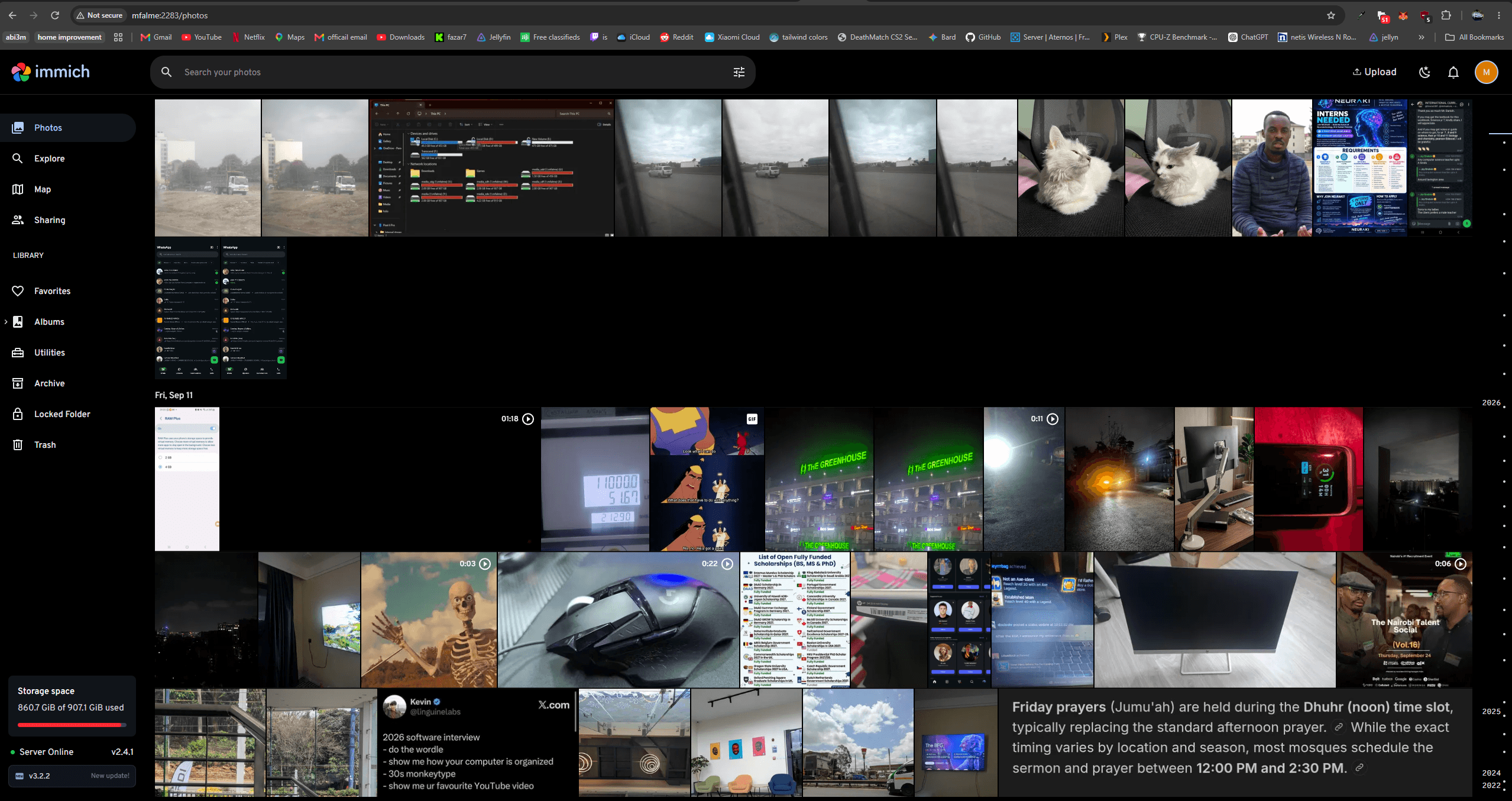
You get a timeline, albums, sharing, automatic mobile backups, facial recognition, search, and a proper interface for browsing your library.
The important part is that you can run it yourself.
No need to build a custom photo API. No need to spend a weekend making a frontend because apparently storing images in folders is beneath me now.
Just deploy it, configure your storage, connect your phone, and suddenly your photos have a home.
And the people behind Immich have clearly put serious thought into the experience. The timeline feels natural. The albums work the way you'd expect. The mobile application makes backing up photos straightforward.
It's one of those applications where you can tell somebody actually cared about the person using it.
The moment it clicked
There's a particular satisfaction in opening an application and realizing you don't need to build anything.
You just get to use it.
For me, that was the biggest surprise.
I'm so used to approaching problems from the engineering side that I sometimes forget software is supposed to be enjoyable to use.
I spend enough time dealing with infrastructure, APIs, databases, deployments, and debugging that finding something polished enough to simply disappear into the background is refreshing.
And then there's the search.
I can look for something like a motherboard and find a photograph I took months ago without remembering which folder I put it in.
That's the magic.
I stopped thinking about where the file was stored and started thinking about what I was actually looking for.
I've spent plenty of time experimenting with local AI through Ollama, so I particularly appreciate seeing machine learning used for something this practical.
Not every AI feature needs to be a chatbot.
Sometimes it just needs to find that one photograph of a motherboard you took eight months ago.
Honestly, that's a pretty good use of artificial intelligence.
Why running it myself matters
I like having control over my own stuff.
I like knowing where my data lives, what hardware it's running on, and how I can access it.
And I particularly like the idea that my photographs aren't exclusively dependent on a subscription whose price increases as my collection grows.
I already own the storage. I already maintain the machines. I already have the infrastructure.
Why shouldn't I use it?
But there's something else I appreciate about Immich.
It gives my homelab a purpose beyond tinkering.
Don't get me wrong. I enjoy tinkering. I have absolutely spent unreasonable amounts of time configuring infrastructure simply because I wanted to understand how something worked.
But having a service that I genuinely use every day makes the whole exercise feel different.
My server isn't just running containers because I thought running containers would be cool.
It's keeping my memories organized and accessible.
That's a pretty good return on all those hours spent debugging Linux.
The setup: My own little Google Photos
I didn't want another cloud subscription. I already had the hardware, the storage, and the infrastructure sitting at home. I just needed something that could turn all of that into a photo library I could actually use.
So I put Immich on my homelab.
The setup revolves around three things: my Linux infrastructure, my TrueNAS storage, and Tailscale.
The infrastructure
My homelab runs on Debian-based machines, with Docker forming a big part of how I manage and deploy services. Storage is handled by my TrueNAS setup, which gives me over 10 TB of capacity to work with.
Rather than treating Immich as another isolated application, I wanted it to fit into the infrastructure I already maintained.
The idea was straightforward:
- Immich handles the photo and video management.
- My existing storage infrastructure provides the capacity for the library.
- My homelab handles running the service.
- Tailscale provides private access to the service when I'm away from home.
The result is a photo library running on hardware I own, without needing to expose the entire server directly to the public internet.
Tailscale: My photos follow me
This is probably my favourite part of the setup.
One of the biggest inconveniences of self-hosting is that your services traditionally live wherever your server lives.
At home, everything works.
Leave the house, and suddenly you're dealing with public IP addresses, port forwarding, reverse proxies, firewall rules, and whatever networking problem you've accidentally created for yourself.
I wanted to avoid turning access to my photo library into another networking project.
Enter Tailscale.
I use Tailscale to connect my devices to my homelab through a private network. Once my server and client devices are connected to the same tailnet, I can reach Immich using its private network address, even when I'm away from home.
Coffee shop? Accessible.
Travelling? Accessible.
Different network entirely? Still accessible, provided my server and internet connection are online.
I don't have to expose Immich directly to the public internet just to access my own photographs.
And because Tailscale handles the connectivity, I don't have to keep manually configuring port forwarding every time I want to access something remotely.
My photos are on my hardware, but they're not confined to my home network.
That's exactly what I wanted.
The mobile experience
The mobile application is where the whole thing comes together.
I can access my library from my phone, browse photographs, and use Immich as my personal photo management platform.
With Tailscale running, my phone can reach the service through the private network connection rather than relying on a publicly exposed endpoint.
It makes the experience feel much closer to using a conventional cloud photo service, except the infrastructure is mine.
And that's the sweet spot I was looking for.
I don't want to spend every day thinking about where my photos are hosted. I just want to take a picture, have it backed up, and find it again when I need it.
The important caveat
Self-hosted doesn't mean magically available.
If my server is offline, my internet connection goes down, or Tailscale isn't connected, remote access is affected.
That's the trade-off.
I'm responsible for the infrastructure, and I accept that.
But for a personal photo library, having private remote access to my own hardware is a trade-off I'm very comfortable making.
I get control over my data, access from wherever I am, and no need to maintain a publicly exposed photo server.
For once, the networking part of my homelab is doing exactly what I wanted it to do.
And that is a genuinely rare feeling.
A note on backups
Now, before anyone gets too excited about self-hosting their entire photographic history, let's talk about backups.
Because Immich is great.
But it doesn't magically eliminate the responsibilities of operating your own infrastructure.
Your photographs are probably some of the most important data you own. Losing them because you forgot to configure a backup would be a particularly stupid way to learn an otherwise very important lesson.
I treat mine accordingly.
That means redundant storage, independent backups of the photographs and database, and a recovery process I've actually tested.
Because, as I've mentioned in my other self-hosting adventures:
RAID is not backup.
Redundancy protects availability. Backups protect history.
And neither is particularly useful if you've never tested whether you can actually recover anything.
I also pay attention to Immich's release notes before updating. With a project this active, I would rather understand what is changing than blindly pull the latest image and discover I've created an entirely new weekend project.
The community behind it
Something I appreciate about Immich is the spirit behind the project.
Someone wanted a genuinely good way to manage photographs, built it in the open, and created something that people keep recommending to one another.
That's one of the things I love about open-source software.
It's not always about building the next enormous platform or creating a business around every possible inconvenience.
Sometimes it's just engineers building something useful because they believe it should exist.
And sometimes that project turns out to be so good that people like me start evangelizing it to anyone who owns a server.
Sorry in advance.
Should you try it?
If you already run a homelab, absolutely.
If you've got a NAS sitting around collecting dust, even better.
And if you don't self-host yet, Immich is one of the more practical reasons I can think of to start.
It's a service you'll actually use. It solves a real problem. And it gives you a reason to learn about storage, networking, deployments, and backups without having to invent an imaginary production workload.
Just remember to back up your data.
Please.
I don't want to write the follow-up article about how I lost every photograph I've ever taken because I thought having 10 TB of storage meant I was invincible.
Anyway, I like Immich.
It's useful. It's polished. It runs on my own infrastructure. And it makes my homelab feel like something more than an elaborate collection of Docker containers and questionable engineering decisions.